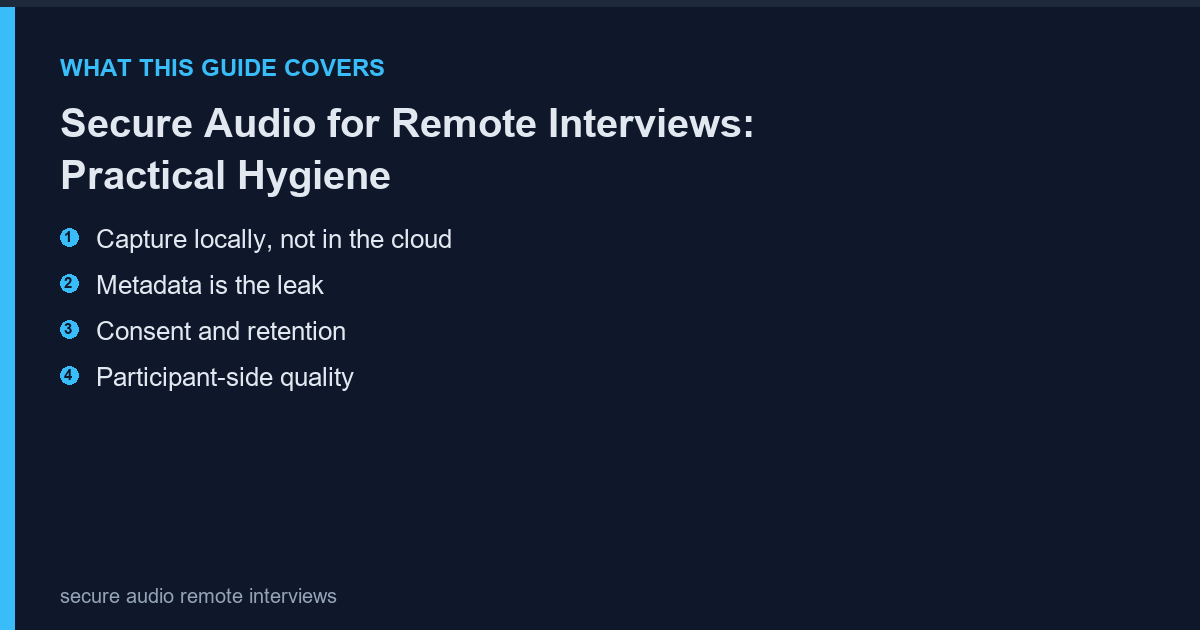
Remote interviews carry two risks: the participant's identity and the recording's metadata. Both are manageable with local capture and a few file-handling habits, without special software.
Capture locally, not in the cloud
Platform recording stores the file on a third-party server under their retention policy. Local capture keeps the recording on your machine, where you control deletion.
- Local capture on your side
- Ask the participant to record their side too
- Avoid platform cloud recording for sensitive topics
Metadata is the leak
Audio files carry device names, timestamps and sometimes GPS. Strip metadata before sharing and never post a raw file from a phone.
| Field | Risk | Action |
|---|---|---|
| Device model | Identifies hardware | Strip |
| GPS | Location | Strip, always |
| Timestamp | Low risk | Keep if needed for provenance |
| Author name | Identity | Strip if pseudonymous |
Consent and retention
State what is recorded, where it is stored and when it is deleted, before recording starts. Retention is the part people forget: an indefinite recording is a liability that grows over time.
- State the purpose before recording
- Agree a retention period
- Delete on schedule, not on memory
Participant-side quality
Ask the participant to use a wired headset or a phone on a stand. A laptop microphone in an open office exposes background conversations that may identify third parties who did not consent.
- Wired headset preferred
- Quiet room, door closed
- No speakerphone in shared spaces
The chain
Recording through the free phone-to-PC microphone software keeps everything on the local machine, which is the simplest way to avoid cloud retention. Apply a high-pass filter and a limiter, export as WAV, then strip metadata before archiving.
Frequently Asked Questions
Is a phone recording secure?
It is as secure as the device. Local capture on a managed machine is easier to control than a phone.
Should I encrypt recordings?
For anything identifying a person, yes. Full-disk encryption plus an encrypted archive is sufficient for most cases.
What about transcription services?
They upload the audio. Use local transcription or a service with a clear retention policy for sensitive material.
How long should I keep recordings?
Define a period before recording and delete on schedule. Indefinite retention is the most common mistake.